
Design check
Results tab, Design check. It reads the whole run and returns what is wrong with the model, ranked, with a locate link on every finding.
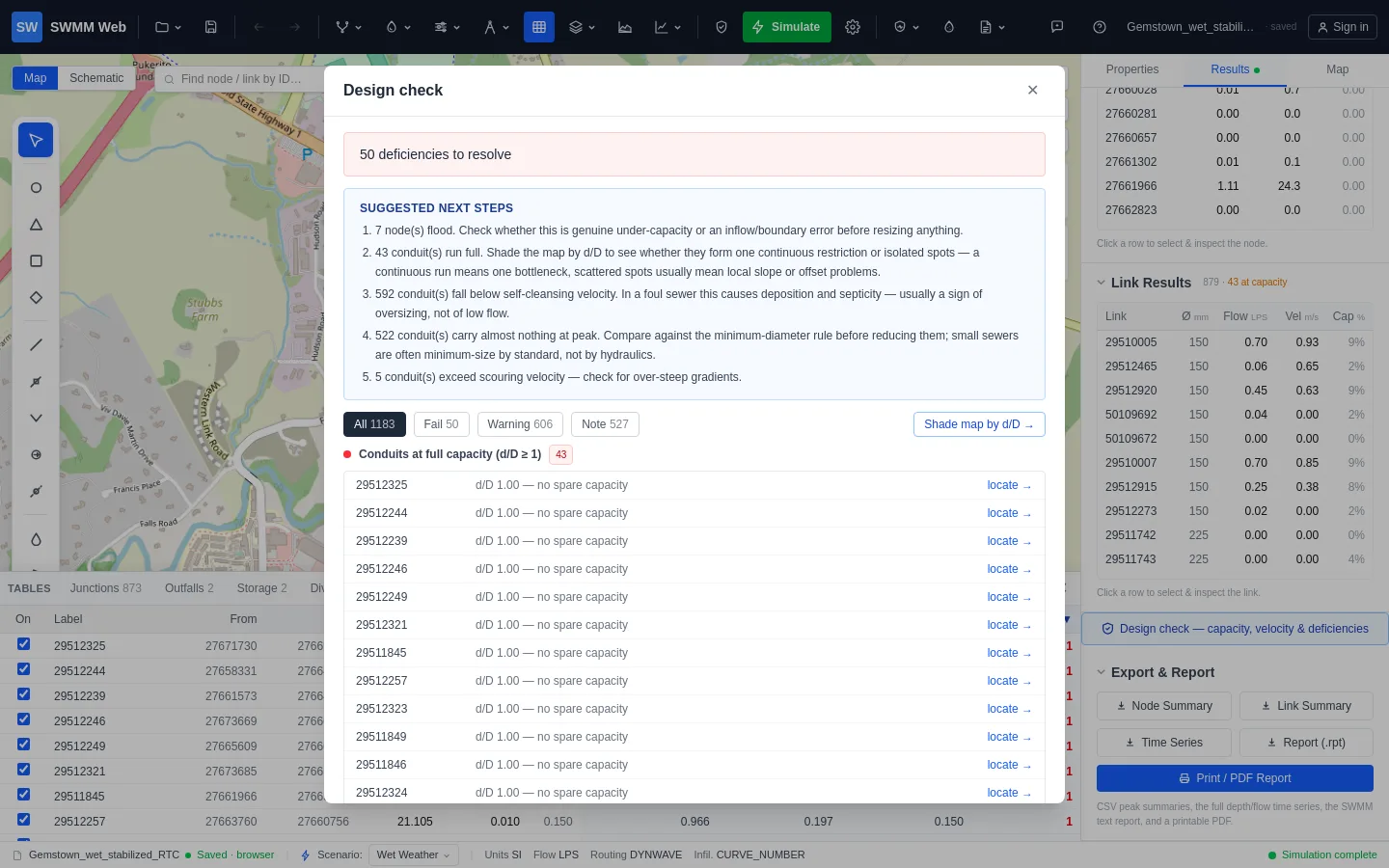
What it checks
Section titled “What it checks”Structural, no run needed: connectivity, links pointing at missing nodes, nodes that cannot reach an outfall, adverse (uphill) slopes, near-flat and very steep pipes, over-deep manholes.
Hydraulic, from the run:
| Finding | Why it matters |
|---|---|
| Flooding | Water is leaving the system at that node |
| Surcharge | Peak level reached the rim, without spilling |
| d/D at or above 1 | No spare capacity |
| d/D at or above 0.9 | Approaching capacity |
| Velocity below self-cleansing | Solids deposit - septicity, odour, blockage |
| Velocity above scouring | Erosion risk, usually over-steep gradient |
| d/D under 0.1 at peak | Possibly oversized |
Thresholds follow the model’s unit system: 0.6 m/s in a metric model, 2.0 ft/s in a US one.
Suggested next steps
Section titled “Suggested next steps”Below the summary is an ordered list of what to do. The order is deliberate, and it is ordered by what invalidates what:
- Connectivity first. Flow that cannot reach an outfall makes every downstream result meaningless.
- Then slope. An adverse slope distorts the whole hydraulic grade line.
- Then flooding, checked for whether it is genuine under-capacity or an inflow error.
- Then sizing.
A model that cannot drain is not worth resizing. That is why “fix drainage” always comes before “resize conduits”.
Oversizing is a real finding
Section titled “Oversizing is a real finding”Engineers instinctively treat undersized pipes as the problem. Oversized foul sewers are also a defect: at low fill the velocity drops below self-cleansing, solids settle, and you get septicity and hydrogen sulphide. The check flags both directions, and the tension between capacity and velocity is usually the actual design problem.
In the printed report
Section titled “In the printed report”The design check appears in the printed report as grouped findings with the worst elements named, plus the same next steps - so the analysis travels with the model rather than living only on screen.